
From Data Analysis to Execution: Understanding How Quant Trading Really Works
For many, the first thing that comes to mind when hearing "Quant Trading" is a room full of engineers staring at code or a mysterious "black box" powered by AI. Others see it as a high-tech tool to predict market swings and find a "magic formula" for making money.
In reality, what we do at UC Capital is closer to the scientific study of market behavior.
Markets are always moving; prices shake, volume shifts, and investor moods change. For a quant team, we don't just look at one-off price moves. Instead, we look for patterns in the data that show a consistent trend. We then turn these patterns into actionable edges, which are strategies based on probability.
Quant trading isn't just about "trading with a computer." It is a process of gathering data, researching ideas, and testing them. We strive to understand how the market behaves, turn that into a strategy we can test, and then use code to execute it precisely.
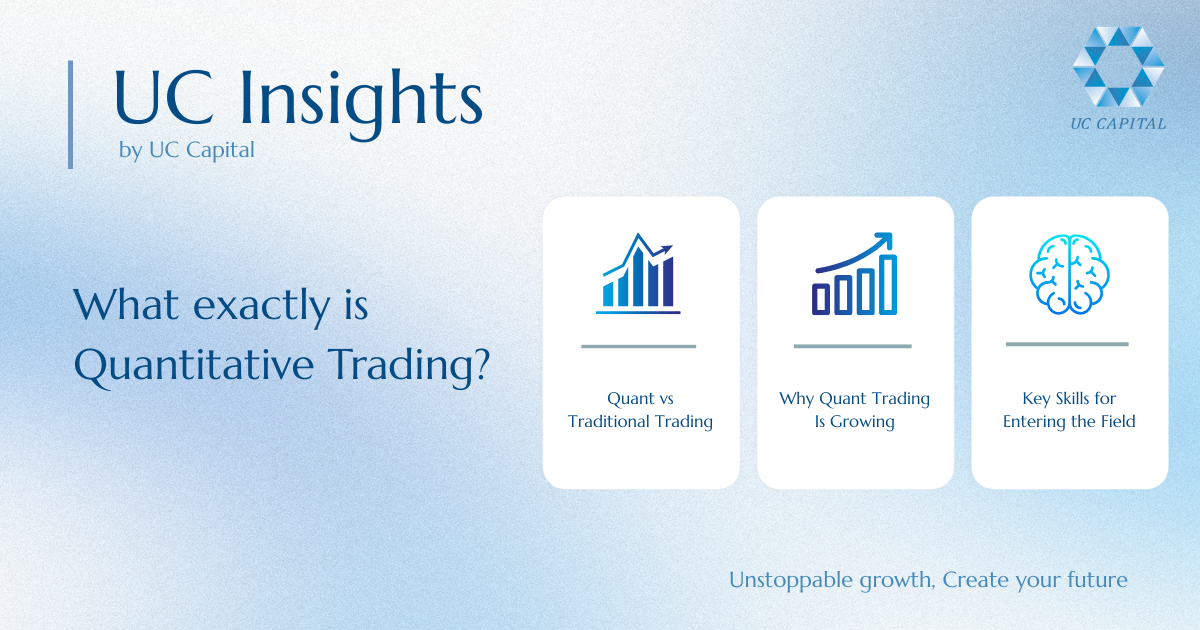
▌ Quant vs Traditional Trading: What's the Real Difference?
Every trader has their own way of looking at the market. While some rely on gut feeling or deep research into a single company, the biggest difference for us is scale and consistency.
Humans have limits. Even the best trader cannot watch thousands of stocks at the same time or make perfectly calm decisions every single second. The core value of quant trading is that it can do what humans physically cannot: monitor everything at once and react instantly.
We turn our research and risk rules into a system. This allows us to work alongside human limits and stay competitive in the market over the long run.
▌ Why We Choose the Quantitative Approach
In today's fast-moving markets, quantitative trading has become a prominent approach. We choose this path not just because of better technology, but because it helps manage the biggest risk of all: human nature.
At UC Capital, we embrace this framework for three simple reasons:
1. Managing Psychological Bias: Trading is stressful. Under pressure, it is easy to second-guess yourself, such as holding onto losses too long or selling winners too early. By using data and logic, we remove fear and greed from the equation and stick to the plan.
2. Pure Consistency: People have "off days" due to stress or fatigue, but a quant system does not. No matter how volatile the market gets, the system stays steady 24/7. This consistency ensures that our decisions are not affected by external noise or temporary moods.
3. Constant Improvement Based on Facts: Once a strategy is systematized, we can test it scientifically. We do not have to guess if it works; we use data to see exactly where we can improve. This cycle of identifying a problem, fixing it, and testing it again keeps us moving forward.
▌Advice for Beginners: It's Not Just About Coding
If you are interested in quant trading, do not just focus on learning tools or languages. Focus on these three mindsets:
1. Think in Probabilities: Quant trading isn't about being right every single time; it is about finding a strategy that works over a large number of trades. Do not get distracted by a single win or loss. Always look at the long-term results.
2. Learn to Break Down Problems: When the market moves fast, you need to break down complex feelings into simple and logical rules. Being curious and knowing how to take a problem apart is often more important than writing "fancy" code.
3. Be Honest with the Data: This is the hardest part. Data does not lie, but it is easy to trick yourself into thinking your idea is better than it is. A great quant trader has the courage to admit when they are wrong and uses that insight to build a better strategy.